Health and Wellness · Case Study
Haven
This project focuses on designing a digital wellness companion that helps college students recognize and manage early signs of burnout. The goal is to create a simple, supportive experience that encourages intentional breaks, tracks emotional patterns, and helps students maintain balance between productivity and mental health.
A student burnout companion
College students struggle to recognize and manage early signs of burnout due to constant academic and social demands. They need a simple, supportive way to take breaks, track emotional patterns, and maintain balance between productivity and mental health.

How can we help college students prevent and recognize the signs of burnout?
Competitive Research
Where do we start?
Loudon Noukes and I worked as a team to evaluate existing solutions to this problem. Although some solutions weren't targeted towards college students, the solutions were ideal for aspects of our product.
Research
Classification
Loudan and I worked together to identify the typical types of burnout that humans encounter.
Research Insights
Insights
From our research we pulled quotes of specific ideas or topics that our product should address and solve for.
When you experience burnout, your self-control wanes...compromises your decision-making and self-control
Burnout tends to come from trying to do too much. So the first step is to figure out what you can live with removing from your plate.
What I often find with college students when they're burnt out with school is that something else is going on that compounds that feeling.
"Pushing through" will only make things much worse. The longer you burn, the harder it will be to recuperate.
While in college, students often experience something entirely different than their past experiences in school.
Disconnecting is the most important burnout strategy on this list, because if you can't find time to remove yourself electronically from your work, you've never really left work.
You don't push through it. That's the trap of burnout mentality — you retreat and rest.
This dip in satisfaction makes work very difficult, because no matter what you're putting in, you don't feel like you're getting much out of it.
Solutions from Research
Encouraging mindfulness practices, such as meditation, deep breathing exercises, and yoga.
Ask for system change: individual coping helps, but organizational and institutional reform are essential for sustained change.
"Teaching students effective time management skills can help them balance academic, clinical, and personal responsibilities."
Encouraging educators to prioritize self‑care and participate in wellness programs.
"If you feel like you're being tasked with too much, have a conversation with your manager about working on high‑priority items exclusively."
Reconnect with purpose: when you remember why you started, you fuel resilience.
"Offering academic support services, such as tutoring, study groups, and skills workshops."
Delegate or say no: learning to decline or ask for help is a core part of recovery.
"Place a hold in your calendar for lunch or breaks. Take your vacation days."
"Establishing peer mentoring programs can provide students with guidance and support from upperclassmen."
Providing creative outlets and ensuring your strengths are magnified helps prevent burnout.
Engage in reflection: check in with yourself regularly. Are you aligned? Are you rested?
Promoting regular physical activity, balanced nutrition, and adequate sleep to enhance resilience to stress.
Institutions should distribute workloads more equitably and limit excessive administrative tasks.
Cultivate rest as an active practice, not a passive by‑product of exhaustion.
Build creativity into your life — not just as a hobby, but as a way to express, recharge, and reset.
Active recovery practices are needed to support our well‑being.
Scheduling relaxing activities makes certain they happen and gives you something to look forward to.
You need to intentionally push everything to the side and just exist.
Sleep. Meditate. Walk outside. Listen to music. Just enjoy the moment of peace you have.
Solutions to Implement
Encouraging mindfulness practices, such as meditation, deep breathing exercises, and yoga.
"If you feel like you're being tasked with too much, have a conversation with your manager about working on high‑priority items exclusively."
It sounds simple but all you need to do is sleep. Meditate. Walk outside. Listen to music.
Engage in reflection: check in with yourself regularly. Are you aligned? Are you rested? Are you still motivated?
Research Findings
Our Product's Focus
"Offering academic support services, such as tutoring, study groups, and skills workshops, can help students feel more confident and capable in their studies."
Our product is aimed to guide solutions for your mental space, not your academics.
Reconnect with purpose: when you remember why you started, you fuel resilience.
Most college students DO understand why they're on the path they chose.
Providing creative outlets and ensuring your strengths are magnified helps prevent burnout.
Creative outlets such as journaling are easy to add to our product to make the experience more personal.
Engage in reflection: check in with yourself regularly. Are you aligned? Are you rested? Are you still motivated?
Creative outlets such as journaling are easy to add to our product to make the experience more personal.
Delegate or say no: learning to decline or ask for help is a core part of recovery.
Downloading or interacting with our product is already an "ask" for help.
Competitive Research
The competition.


Competitive Analysis
| Core Focus / Value Proposition | Key Features | Unique Strengths | Weaknesses / Gaps | |
|---|---|---|---|---|
| Meditation, sleep, relaxation — "#1 app for sleep, meditation, and relaxation" | Guided meditations; breathing exercises; mood tracker; sleep stories; nature soundscapes | Very strong brand, wide usage, both sleep & mindfulness verticals; high-quality content; trusted in wellness space | Less student-specific; heavy subscription; content-rich but might be overwhelming; limited integration with academic routines |
| Meditation & mindfulness with wide reach; also sleep support | Guided meditation sessions; sleepcasts; mood tracking features; personalization | Strong beginner onboarding; broad audience; strong visual/UX design and brand recognition | Again, not specifically designed for burnout or student lifestyle; may lack short-micro-break focus or academic context |
| Journaling & mood tracking + guided journaling prompts & reflection | Morning planning & evening reflection; mood tracker; habit tracker; guided journal templates | Focused on reflection, habit build-in, minimalist UI; strong for self-awareness and inner work | More oriented toward journaling than micro-breaks or energy tracking; may require consistent user discipline; less gamified or study-specific |
| Habit-tracking + wellness + virtual pet gamification ("birb") | Virtual companion; users care for pet by completing daily wellness tasks; habit tracking; social elements | Gamified self-care; fun, playful, less serious tone; good for engagement and habit formation | Possibly less deep on the "burnout/energy" domain; more game-like so might not always convey serious wellness/science; broader audience than student-specific |
| Productivity / focus tool; encourages staying off phone via growing trees while you focus | Timer/Pomodoro style focus sessions; gamified tree-growth; ability to tag sessions; statistics; optional phone-blocking mode | Strong focus on distraction reduction, visual reward system; good for students/academics looking to stay on task | Focused more on productivity/task focus than emotional/energy tracking or micro-rest breaks; less wellness/mind-body integration |
Insights for our app
Good benchmark for quality of content; shows what premium wellness apps deliver. Our product can learn from their content but aim for the student niche
Helps understand how a strong wellness UX looks. Our app could adopt some of their onboarding and personalization strengths but tailor it towards the student burnout niche
Our product's emotion and burnout pattern features could borrow ideas from Stoic's reflective framework
Our product could borrow gamification/habit-formation elements from Finch but ground it in serious burnout/energy awareness for students
Shows value of gamified focus mechanics for students. Our product could incorporate focus-session awareness as part of burnout tracking
Structure
After understanding what other apps offer users, we came up with a few key features that we hoped would successfully help college students facing burnout.
User Persona
Emily Clifton
Meet Emily Clifton! A Sophomore in college studying pre-med. With the balance between lectures and labs that can last hours, she has started to feel burnout and needs a way to cope with this stressed feeling so it doesn't worsen.
“Pre-med is my favorite thing ever but even your favorite things can get tiring.”
- Track her burnout in a way that emphasizes her self-awareness.
- Easily find ways to catch her burnout and poor mood early so she can practice coping skills.
- There are too many tools that forces her to spend time learning them.
- Too many features can cause option-paralysis.
- Data isn't visual enough for her busy life.
- Visualizations and simple steps.
- Track her progress and be able to quickly enter her mood.
Wireframes
The Design Process
Now that we knew what features were needed and would be used by our target audience, we started putting our words into wireframes.
Wireframes
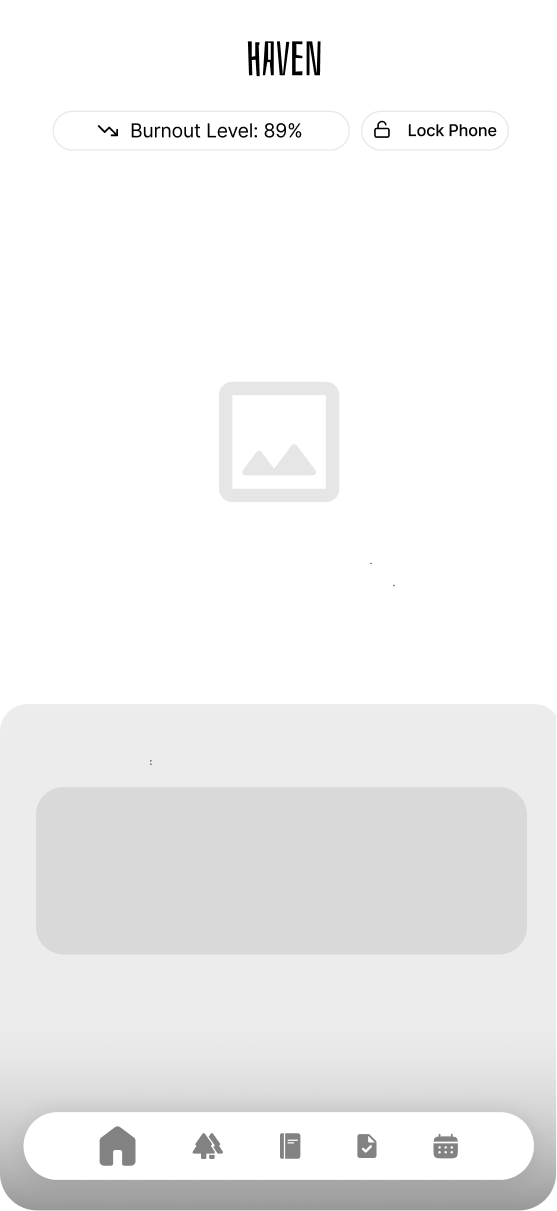
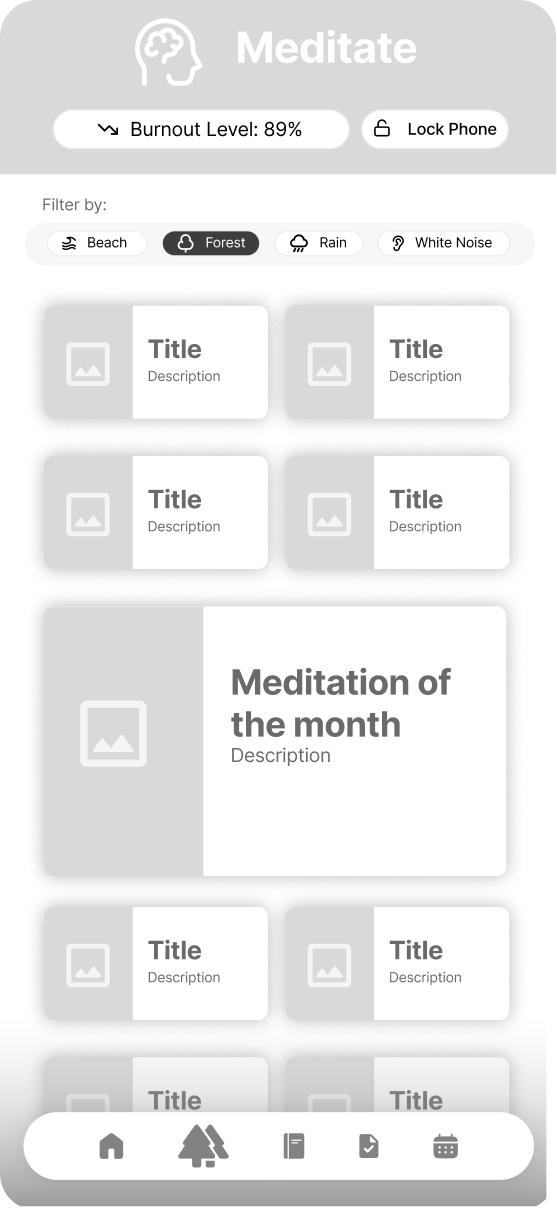
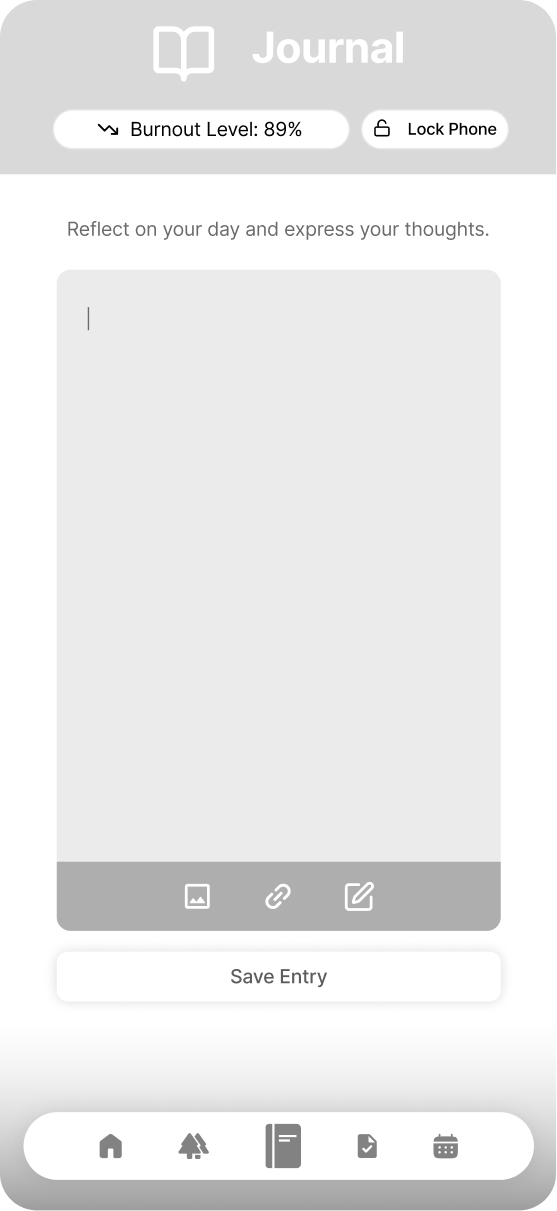

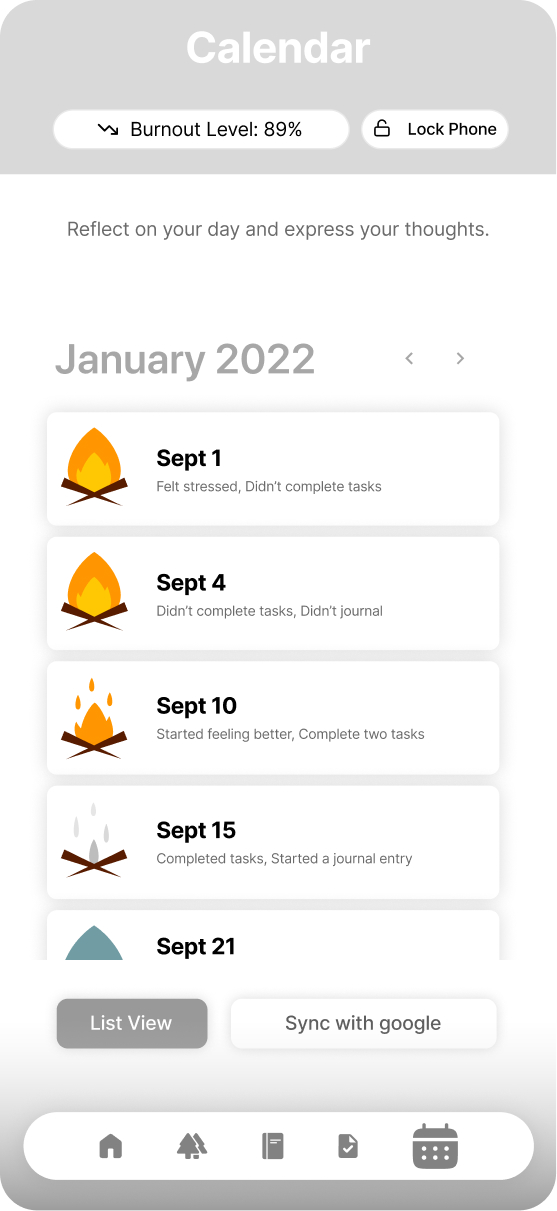
Wireframes
Onboarding
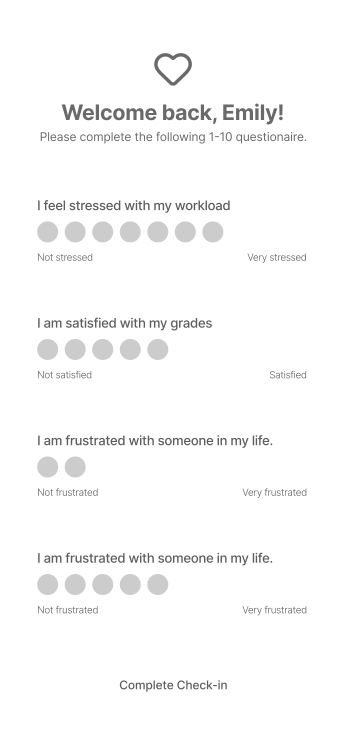
From our research, we learned that daily check-ins can be super beneficial in creating better habits for individuals struggling with burnout or academic stress in College.

Home Screens
Home Screens
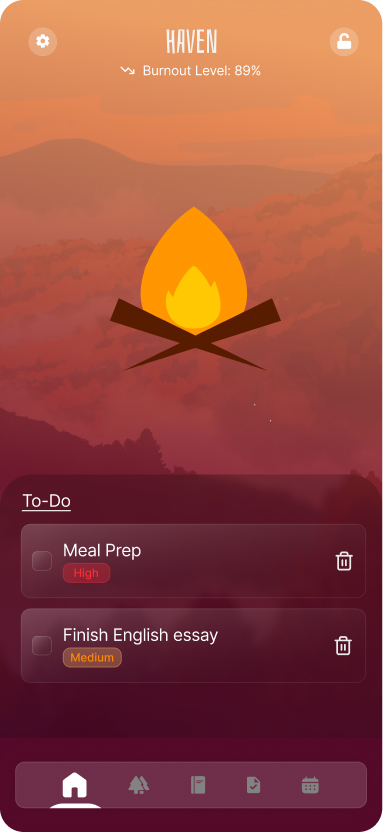
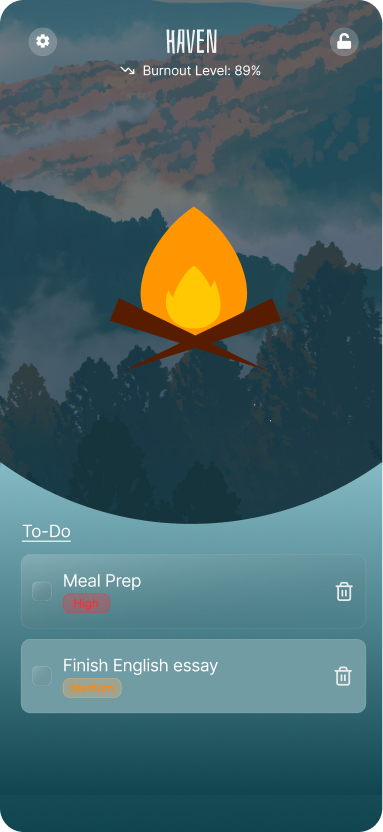
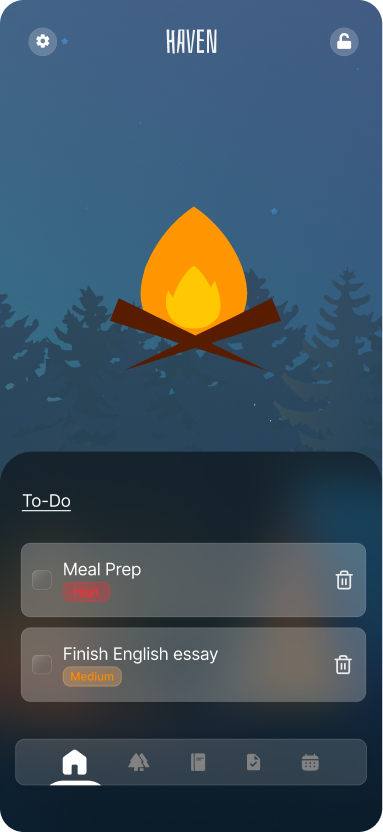
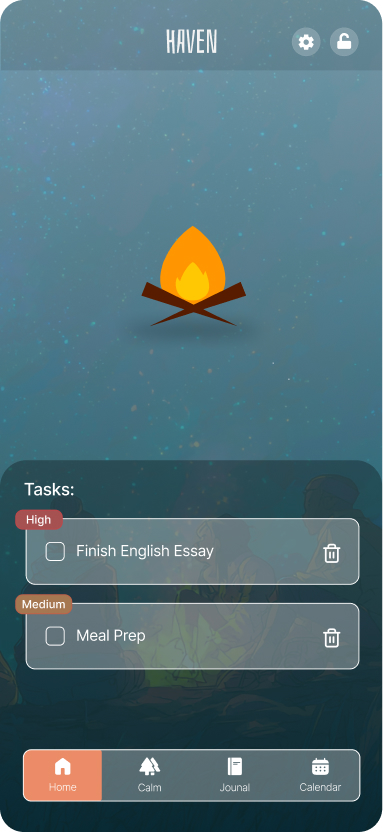
After wire-framing our ideas, we began ideating on the overall style and feel of our app. We wanted a way to resemble your “burn out” getting “put out” like a fire, but we weren't sure what colors and styles accented that well.

Final Prototype
Final prototype
This final prototype delivers a calm and intuitive wellness experience that guides users through daily check-ins, reflections, and personalized emotion tracking.
User testing
After prototyping our final designs we took it to real users, giving them the chance to go through this prototype and find common frustrations or pain points that weren't previously identified.
That might actually be the most useful part so you can eventually see progress over time.
Takeaways
- ·Calendar visual is most useful for users
- ·Strong emotional design (calm, cozy, inviting)
- ·Extremely intuitive onboarding & navigation
- ·Clear value in tracking & reflecting on emotions
- ·Content density (too many choices)
- ·Clarity issues (icons, contrast)
- ·Micro-interactions (loading, feature visibility)
- ·Lean more into tracking progress feature
Where we went wrong
- ·Do user testing earlier on with wireframes.
- ·Find more participants for user testing
- ·Further refine key features (journaling and meditation)
- ·Add more visualizations (animations for meditations)